How to Style Flowers at Home

Less about rules, more about developing an eye for what works.
Most people underestimate how much difference a well-placed stem can make to a room. And most people overcomplicate it. Styling flowers at home isn't about following a formula, it's about understanding a few simple principles and then trusting your own judgement.
Here's how we think about it.
Start with the vessel
Before you think about stems, think about what they'll sit in. The vessel does as much work as the flowers themselves, it sets the tone, defines the shape, and anchors the arrangement in the room.
A wide-mouthed ceramic jug suits loose, relaxed arrangements. A narrow glass cylinder creates height and draws the eye upward. A low, wide bowl keeps things close to the surface, good for dining tables where you don't want to talk across something tall.
Build a small collection of vessels in different heights and materials over time. Earthy stoneware, aged brass, clear glass, each brings something different, and having options means you can respond to what the stems are asking for rather than forcing them into something that doesn't suit.
An odd-shaped or imperfect vessel is often more interesting than a pristine one. Don't overlook charity shops and markets, some of the best containers aren't sold as vases at all.
Think about proportion
A common mistake is placing an arrangement that's too small for the space it's in, or too large for the vessel it's sitting in. Proportion matters, not because there are strict ratios to follow, but because something that's visually off-balance draws attention to itself for the wrong reasons.
As a starting point: aim for stems that are roughly one and a half times the height of your vessel. From there, adjust based on what looks right to you. Trust what your eye tells you.
One well-chosen stem in the right vessel can do more than a dense arrangement that doesn't know where to look.
Place thoughtfully
Where you put flowers in a room is as important as how you arrange them. They tend to work best when they have a clear relationship with the space around them, sitting alongside other objects, on a surface with breathing room, in a spot that gets some natural light.
Avoid tucking them away in corners where they can't be seen, and avoid placing them where they'll compete with something else that's fighting for attention. Flowers work well as a focal point, or as a quiet complement to one, but rarely as an afterthought.
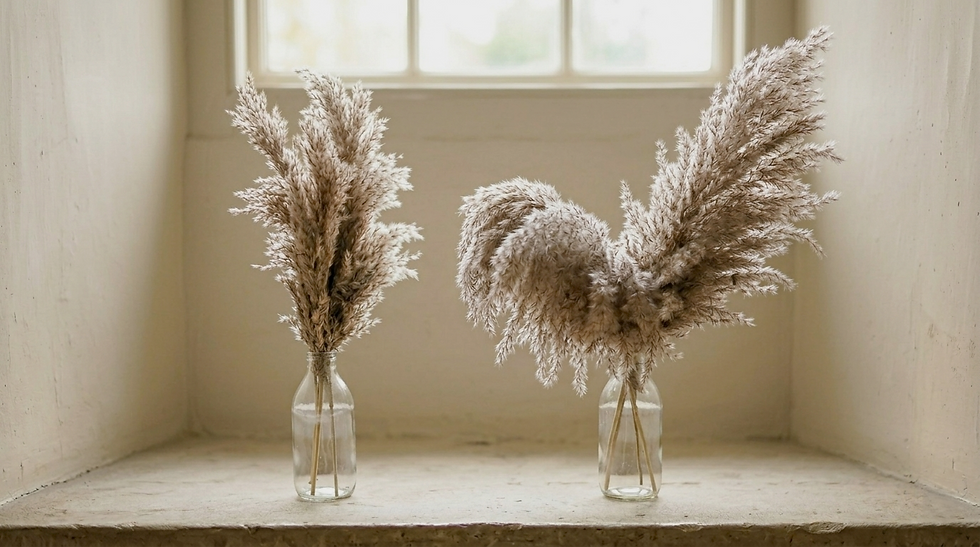
A single stem on a bedside table, a bathroom shelf, or a kitchen windowsill can be more effective than a large arrangement in a room that doesn't quite need one. Think about where you spend time, and let that guide you.
Edit before you add
When arranging, the instinct is usually to add more. More stems, more variety, more fullness. More often than not, the arrangement improves when you remove something instead.
Before you decide something is finished, take one element away and see how it looks. If it's better, or if you don't miss what's gone, you've found your edit. If something feels absent, put it back. The point isn't minimalism for its own sake; it's clarity. An arrangement that knows what it is always reads better than one that's trying to be everything.


Comments